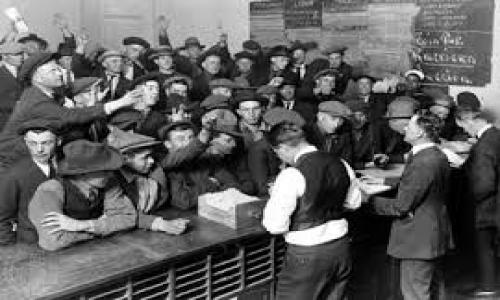
Dow Jones Industrials Crash Analysis - Great Depression Versus Today

Article Submitted by: Sol Nasisi
The Economy


I've wondering how the performance of the Dow in 2008 compares to the drop during the Great Depression. To find out, I graphed both and set them side by side. The results are interesting...


Submitted: Nov 19, 2008    Views: 33102    Comments: 34    Likes: 13   


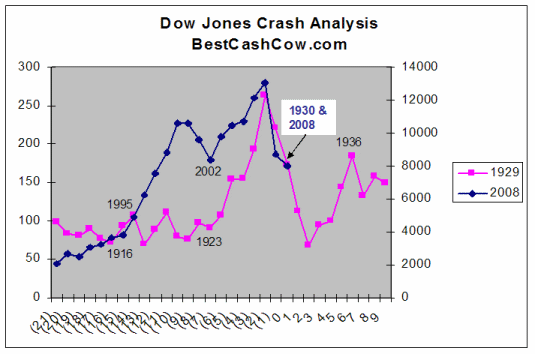
Today, as I watched the Dow sink below 8,000, I wondered how the sell-off of the last six months compares to the sell-off during the Great Depression.  The chart below shows what I found.  To create it, I graphed historical data taken from the DJ Indexes website for the Dow Jones Industrial Average.
  DowJonesCrashAnalysis-DepressionandToday

Let me explain how to read the chart.

The years 1930 and 2008 are time 0 on the x axis of the graph.  I then looked at the 21 years before 1930 and 2008 to see how the markets performed before the 1930 and 2008 crashes.  I also charted the 10 years after the crash in 1930, represented by the positive numbers on the X axis.  The left Y axis shows the Dow's price during the early part of the 20th century and the right Y axis shows the Dow's price in more modern times.  One other note on the methodology is that I used the closing price of the Dow on November 11 of each year.

As you can see by looking at the blue and pink lines, before both crashes there was a sharp run-up in the value of the Dow.  But the data shows that the pre-crash bubble is much bigger now than it was prior to the Great Depression.  While the Dow increased about 2.5x during the priod 21 years before the crash of 1929-1930, it increased over 6X from 1988 to 2008.   

In 1929, with Black Friday, the Dow began to deflate and it hit a bottom in 1932.  By that point, the Dow was down almost 75% from its peak a few years earlier.  Today, the Dow has fallen about 42% from its high of 13,850.  As the chart shows, if this economic downturn is not over and comes close to approaching the early severity of the Great Depression, then the Dow is not done falling.  It's important to note that the largest damange to the market happened at the beginning of the Depression.  While economic problems continue until the beginning of World War II, the stock market began to recover from its lows in 1936.  What does that mean?  It means that even if our current downturn doesn't last as long as the Depression, it could be as deep for a concentrated period of time, and during that time cause further equity losses.

I don't usually use Wikipedia as a source but I came across this entry on the Great Depression and thought it appropriate.  You can decide if there are parallels to today:

The Great Depression was not a sudden total collapse. The stock market turned upward in early 1930, returning to early 1929 levels by April, though still almost 30 percent below the peak of September 1929.[6] Together, government and business actually spent more in the first half of 1930 than in the corresponding period of the previous year. But consumers, many of whom had suffered severe losses in the stock market the previous year, cut back their expenditures by ten percent, and a severe drought ravaged the agricultural heartland of the USA beginning in the northern summer of 1930.

In early 1930, credit was ample and available at low rates, but people were reluctant to add new debt by borrowing. By May 1930, auto sales had declined to below the levels of 1928. Prices in general began to decline, but wages held steady in 1930, then began to drop in 1931. Conditions were worst in farming areas, where commodity prices plunged, and in mining and logging areas, where unemployment was high and there were few other jobs. The decline in the American economy was the factor that pulled down most other countries at first, then internal weaknesses or strengths in each country made conditions worse or better. Frantic attempts to shore up the economies of individual nations through protectionist policies, such as the 1930 U.S. Smoot-Hawley Tariff Act and retaliatory tariffs in other countries, exacerbated the collapse in global trade. By late in 1930, a steady decline set in which reached bottom by March 1933.

The quote doesn't touch on the obvious parallels in the banking system.  Although there haven't been as many bank failures, the magnitude of the financial failures today are enormous - Bear, Lehman, Fannie, Freddie, Wachovia, Washington Mutual, Countrywide, National Citi, AIG.  I realize not all of these were failures but many of the banks listed were purchased at firesale prices to prevent a failure.

The question to ask yourself about this recession is whether you think it's like the relatively mild downturns of 2001-2002, and 1991-1992 and even 1980 or is it really the worst economic downturn since the Great Depression?  Because if you believe the latter, then that blue line has further to fall. 


Sponsor Updates and Offers

Sign up for Zions Direct’s free weekly newsletter.

Get market information, CD and Bond auction updates, new-issue alerts and more.


Related Articles:


13

Email this story Email to someone | Print Story Print Content | Add to reading list

Comments Received:

Barry Baker
(Unregistered)

Very insightful analysis and a good provision of context for the worst case scenario. The author is obviously brilliant and on-point. I have a request...can you research the comparable volatility of the Dow during the same periods?? Does the author think we are going into the Great Depression II?

Keep up the great work!

Posted: Nov 20, 2008

Here's an interesting article comparing today to the Depression. I'm not as optimistic as the author but I also don't think things will be as bad the Depression.

http://www.kiplinger.com/features/archives/2008/11/depression_not_coming.html

Posted: Nov 21, 2008

Chuckoo
(Unregistered)

Nice chart! I wonder how do you scale the two Y axes. As they are drastically different price range for the two periods. Depending on how you scale it, the downward slide that we are supposingly in as the chart suggests, may have a lot more to go or that we are already done. Thanks.

Posted: Nov 24, 2008

Mungdavu
(Unregistered)

Who really knows what is going to happen......all the charts, numbers, and/or data is never going to be able to predict the future. I suggest everyone to take a listen to some REO Speedwagon and "Ride the Storm Out", because that is about all we can do at this point...... Keep Pushin' is what I say....

Posted: Jan 8, 2009

Pam
(Unregistered)

Thank you!

Posted: Jan 9, 2009

Karl
(Unregistered)

If that is to happen, and it quite possibly will, the next drop or boom will happen in the next couple weeks. I am personally betting on an Obama rally, but am preparing to exit the market if the S&P 500 drops below the level hit at the end of the last cycle.

Posted: Jan 14, 2009

Anette
(Unregistered)

Financials are melting down this week. Roubini says finacial system is insolvent. I think we have further down to go.

Posted: Jan 20, 2009

William A.
(Unregistered)

I too believe the blue line has a long way to fall yet. I'm afraid that with the new stimulus package and the abysmal failure of the first, the commercial tsunami on the way and all the political bickering we will see a 5 or 6000 on the DOW before the end of 2009. God help us, I hope I am wrong.

Posted: Jan 26, 2009

ellsfran@aol.com
(Unregistered)

If I had my way, we'd stimulate the economy by lowering individual's tax rates rather than issuing stimulus checks.In that way the economy would be stimulated each payday with people spending the extra money rather than saving it or paying off debts.Second,banks are afraid of toxic mortgages on the other bank's balance sheet. therefore, instead of just giving them money, guarantee their loans to one another otherwise they'll just use the bailout money to finance their cost of doing business and won't have to loan out money to stay in business, thus prolonging the credit crunch.

Posted: Jan 28, 2009

jake stringer
(Unregistered)

i loveeeeeeeeeee mennnnnn

Posted: Feb 19, 2009

Bubba
(Unregistered)

What about the price difference between then and now, I think that would indicate we are in the Great Depression II, because today we sure cannot go out and buy a loaf of bread for $0.05, or see a movie for $0.25 or even buy a new car for the price it was back then. Do these people not even realize this... Or are they just not bringing it up to keep peace in America.

Posted: Feb 22, 2009

watashi-A_hadiputro@hotmail.com
(Unregistered)

Thanks for this article. I'm currently starting on a research paper for my U.S. History class and this certainly helped me start. If you have any more informations, like the suicide rate, or crime rate of the two period, it'll be a big help. Thanks.

Posted: Feb 22, 2009

'Dupe
(Unregistered)

This is a brilliant comparison of these 2 periods. Will look out for more information. Thanks for sharing.

Posted: Feb 23, 2009

Econometrics
(Unregistered)

While the financial crisis situation is simlair you need to factor out two key differences:

1) If FDIC can stay above water and people continue to keep their money out of their matress, the volitility shouldn't be as bad (lesser dive, but probably slower recovery). As long as capital is available, it can create jobs when the stimulus finally kicks in.

3) At least currently (knock-Knock)- we have no major (oil or food) shortage as did the great depression (Dust bowls)

Posted: Feb 23, 2009

Oakridge
(Unregistered)

This is an interesting comparison. However, Hoover didn't let the Federal goverment react so we lost a few years from '29-'32. It took Roosevelt to start getting the Federal government into the act in '32 and '33 and things started to improve even though many of his programs were temporary. Perhaps Obama's program will cause a quicker recovery. It all depends on employment.

Posted: Feb 26, 2009

Jacob Fries
(Unregistered)

I predict DOW 5,600 by year's end and a final bottom during the depression in coming years, below DOW 2,000. That is what an axiomatic reading of 1929 and the 1930s indicate, compared to 2008 and 2009. I trust history to repeat itself because people do not learn from their mistakes, least of all governments. There will be a Greater Depression.

Posted: Feb 28, 2009

wb
(Unregistered)

The unfortunate difference between today and the Great Depression is that we had brilliant people come in to run the economy in 1932. Today, we have a bunch of thugs who are bent on recasting the socio-economic system.

Posted: Mar 1, 2009

Sarb Gill
(Unregistered)

Since the government is using quantative easing (printing money) I think the DOW will bottom in nominal terms in the middle of next year around 3700.

Buy gold or other real assets to protect yourself.

High Inflation is very lickley!!

Posted: Mar 3, 2009

Turner
(Unregistered)

Nice analysis! Thanks.

Posted: Mar 5, 2009

Confused
(Unregistered)

To Econometrics today I read the us farmers are not planting corn because the price per bushel is way below the cost of growing it,there goes the food Cheers

Posted: Mar 5, 2009

Louay S
(Unregistered)

One major difference that drive the economy more than supply and demand is productivity, and since the use of personal computer (1989) and Internet (1995) Productivity went up by far more than the creation of agriculture tools or even electricity, so we can't compare 1929 heap of bubble by a true growth of 199x and early 200x. That is part of the 6X compare to 2.5X.
Let me ask any one this: without a PC and Internet, how match less your productivity will go down?

Posted: Mar 7, 2009

Adenovir
(Unregistered)

Excellent chart...I put a link up on the Motley Fool:

http://boards.fool.com/Message.asp?mid=27504094

It really depends on where you call the start of bull market. The pre-1929 run-up is clearly steeper but our current run-up is larger in magnitude. At this point we are further down than 1930. It may in fact be a race to the bottom.

Thanks!

Posted: Mar 8, 2009

Jerrold Peterson
(Unregistered)

The Stock Market bubble and crash of 1929 and 2008-09 have the same general cause: mal-distribution of national income. From 1910-1930 monopolies in most of the major industries redistributed income away from labor to capital. This non-market redistribution of income left labor unable to demand the products that industry was producing. From 1980-2008 the deregulation of the economy allowed the capitalist class to again redistribute income away from labor to capitalists. This redistribution, again, left labor unable to buy the houses and autos among other things that industry is producing. Louay S is in general right.

Chamois an old economist


Posted: Mar 9, 2009

nope
(Unregistered)

Valuations were not as inflated in 2007 as they were in 1929. The fall has been just a precipitous, but the absolute decline just won't be as severe. We may have already hit the bottom actually.

Posted: Mar 10, 2009

Bazza
(Unregistered)

Nice analysis. An alternative and maybe surer base might be the longer term level of the index without the bubble. From your charts, the 1929 level might be about 130 and the Dow fell to say 70. The present base level might be about 10000 so an equivalent fall would take us to about 5400, which is about where Jacob Fries thinks it will be at the end of 2009. Still not pretty.

Posted: Mar 12, 2009

Sarah South Jersey
(Unregistered)

apologize for non economist comment:

due to mind boggling incomparable difference in information sharing globaly and corresponding awareness of global economic impact & hardship -- seems the powers are going to squeeze the best and the brightest to stop the hemorrage and it shouldn't collapse as badly as in the OLDEN DAYS (1929)

now the whole fungus mushroom of exploding population WANT to survive and enjoy life and not participate in apocolyptic wallowing in reality show misery

which leads me to believe the captains will right the ship

as Nope suggests, we may be sailing again now, albeit with a sputtering engine.

Posted: May 5, 2009

Alex
(Unregistered)

i think the stock market is close to crashing again and we will soon have another great depression

Posted: May 12, 2009

StupidOne
(Unregistered)

Alex, I agree with you (we are in for some tough times, I don't think a depression though). I think the market was fluctuating a bit trying to make sense of things. With the bankruptcy of Chrysler and the pending bankruptcy of GM, I think we are in for some tough times. Look at the store closings in the retail sector, retailers are closing more stores than they had planned to. Yes, the layoffs went down quite a bit but I think some companies are currently in the planning stage to see what is the next step. I think if things continue as is, the layoff numbers will go back up.

Posted: May 12, 2009

raderator
(Unregistered)

The US economy was destined to collapse anyway because of the aging of the boomers and the transition of the US population to 3rd world makeup. The Great Depression happened to a much younger and much whiter country. The cause was the same, Marxist opportunists. Some of Obama's handlers are probably the grandchildren of the very Marxists who heaved Molotov cocktails in Russia and instituted their plans in FDR's whitehouse.

"There is nothing wrong with Communism. Some of my best friends are Communists." -FDR. Obama can make the same claim.


Posted: May 30, 2009

Oneslip
(Unregistered)

I think the major comparison is the fact that in both cases of now & the depression is that it is a credit crisis, the 20's boom times were based on leverage just as the late 90's and early 2000's. In fact the ratios are even more expanded today then in the past. The market has been rallying since March 6th but I feel that this is still a bear market rally, the fundementals are still very horrible in fact the counrty as whole has suffered a huge balance sheet issue. The same thing happened in the 30's, the market rallied 20% and people got confident to get back in and then the market just descended for it's 75% drop, I do think the same can happen. I also feel the S&P is still overpriced & the yield is too low.
I would love to be more positive and I have certainly enjoyed watching my portfolio climb out of the hole but longer term I am not confident.

Posted: Jun 3, 2009

M
(Unregistered)

the best answer for maximum protection is to accept JESUS christ as your personal SAVIOUR

http://www.messianicart.com/shalom/salvation.htm

Posted: Jul 10, 2009

m
(Unregistered)

http://www.messianicart.com/salvation.html

Posted: Jul 10, 2009

Randy
(Unregistered)

I think the market today is going through an accelerated version of the 1930s. The rise that peaked in 1936 is happening now as government cash pours into the economy. Look for a downturn over the next 6 mos. as the cash works its way through and then investors say: what's next?

Posted: Oct 5, 2009

Gus
(Unregistered)

Market back to 8,000. Then it might stabilize.

Posted: Oct 30, 2009


Add Your Comments:

Your Name:

Spam protection control:


© Copyright 2009 Sol Nasisi All rights reserved. Sol Nasisi has granted BestCashCow.com, LLC non-exclusive rights to display this work on Bestcashcow.com.

Financial products of all nature bear inherent risks and this website is not a financial advisory service; it is a forum for users to share and to compare notes and observations on financial publications. The website provides, free of charge, the technical and logistical apparatus and the medium for users to share and to publish financial information and to comment on publications. As such, the website’s operator can not and does not take responsibility for information, observations or opinions of any sort or nature provided by third parties with whom it is not affiliated who use the website to publish, to comment or as a means of solicitation. Users are specifically warned against following any advice related to specific instruments, including, but not limited to, equity securities, that may be provided by other users directly on this site or on web pages to which other users have provided links on this site. BestCashCow.com can not and does not check or verify the qualifications and credentials of users who publish or comment on this site or on linked pages. Users should seek personalized advice from qualified professionals regarding all personal financial issues and evaluate the risks and applicability to their own circumstances of each financial product discussed regardless of who the publisher is or purports to be. Should you, through your use of this site, identify an individual or organization purporting to offer personalized advice, you bear all responsibility to ensure that the individual or organization has the qualifications that they may represent on the website, and that their advice is appropriate for your circumstances. On certain webpages, BestCashCow.com provides information related to rates on US-based savings accounts, CDs, short-term government bonds, and other US cash equivalent securities, also free of charge to internet users for their independent use. The accuracy of this information is not guaranteed, and the information, like all other information on this website, should not be construed to provide investment advice, nor to endorse a financial product of any sort.

© 2009 BestCashCow.com, LLC. All Rights Reserved. Terms under which this service is provided to you. Privacy Policy.