dollars image

1-Year CD Rates from Online Banks 2026

1-Year CD Rates from Online Banks 2026

Recent Articles


PenFed Offers Five Year CD at 3.04% APY

Rate information contained on this page may have changed. Please find latest cd rates.

Pentagon Federal Credit Union (PenFed) upped the rate on its 5 and 7 year money market certificates (CDs) to 3.04% APY, the first return to 3% in a long while for the 5 year term.

Pentagon Federal Credit Union upped the rate on its 5 and 7 year CDs (called money market certificates by PenFed) to 3.04% APY, the first return to 3% in a long while for the 5 year term. That is by far the best 5 year CD rate (check table) with CIT Bank offering the next highest rate at 2.05% APY. The 3% rate is also available in a 7 year money market certificate. In general, I have been arguing against longer-term CDs because I believe that rates are on the rise and it doesn't make sense to lock-in for a long term at a lower rate. But 3.04% is pretty attractive and savers looking for a little extra yield may find this worthwhile. The average 5 year CD rate is 1.079% APY and the BestCashCow Savings Booster Calculator shows that moving money into the PenFed 5 year CD will result in an additional $8,255 in savings on $50,000 over a 10 year period.

Try calculating the extra money you would generate putting money into a PenFed CD.

Almost anyone can join PenFed. Membership is open to those serving in the military or veterans as well as those belonging to a qualifying organization. In general, anyone can become a member by joining one of the participating organizations for a nominal fee. Organizations open to all individuals include National Family and Military Association ($20 one-time fee) or Voices for America's Troops ($15 one-time fee). This is a two for one as you can join worthy organizations and also be eligible to become a PenFed member and take advantage of their competitive rates.

Share Certificates can be opened online, via phone or at a PenFed branch.

Pentagon Federal Credit Union is the third largest credit union in the United States with over $15 billion in assets. All deposita re NCUA insured up to the limit of $250,000 per individual.

Thanks to Shorebreak for letting us know about this rate increase!


The Impact of the Government Shutdown on Bank Rates

Rate information contained on this page may have changed. Please find latest cd rates.

How the government shutdown will impact savings and borrowing rates.

Update: October 14, 2013

Shutdown talks have merged with the debt limit deadline. Washington is now sitting on a double powder keg of explosive news that has the potential to really knock the economy right out of the ring. All eyes have turned to Washington, not where you want the business world to be looking. The WSJ published an article (login required) today saying what we have known from the start, a prolonged government shutdown will hurt the economy and prolong the Fed's bond buying. That means lower rates for longer. Consumer confidence is already plummeting and the stock market is heading down. Throw in a debt default and we will have economic havoc. On days like this, I'm glad to have some of my money in cash, in good solid banks.

Update: October 7, 2013

It now looks like the shutdown talks are going to merge with the discussions on raising the debt limit. We've walked this tightrope before and it is a damaging game of brinksmanship our leaders are playing with the econony. If the issue is not resolved in the next week, look for these talks to create economic uncertainty and anxiety which will reduce growth, dampening interest rates for the next 6 months. In the unlikely case the government does default on its debt, all bets are off. The stock market will likely plunge, and interest rates on longer-term instruments such as mortgages will soar. Short term rates will remain low, as they are set by the Fed. But it might not matter because the financial markets could seize up. The global economic system relies heavily on Treasuries, and the fact that Treasuries are a risk-free instrument.

* * *

After weeks of back and forth bickering, the U.S. Federal government entered a partial shutdown today as Congress and the President failed to reach an agreement on a continuing budget resolution. While the politics of this are best left to other sites, we thought it wise to take a minute and think about what, if any impact this shutdown would have on savings and borrowing rates. The answer? It depends on how long the shutdown lasts and how the government is able to resolve it and move forward. A prolonged shutdown will slow confidence in the economy and increase unemployment, leading to lower rates on mortgages and other loans, as well as on savings and CD products.

Confidence is a mainstay of economic growth. If consumers are not confident about the future, they will delay purchases or not make them at all. Businesses act in the same way. The mad scramble in Washington does little to increase confidence and, if anything, makes both households and businesses wary about investing in the future. In addition, the inability for Congress and the President to agree on the continuing funding resolution bodes ill for the upcoming debt ceiling deadline. If the Federal government remains paralyzed and cannot fund itself, and this carries over to a default on U.S. debt, the results could be economically catastrophic. Why? Because U.S. government debt is considered to be risk free and this assumption is used to not only build portfolios, but calculate the return on projects and business investment. Any default would irretrievably alter this assumption. Domestic and global confidence would be sorely shattered.

The Federal government is the largest employer in the United States, providing jobs to over 4,00,000 individuals. The partial shutdown is expected to furlough 800,000 workers and another 1,000,000 employees are to work without pay. That means that at least 1.8 million employees will not receive payment for the duration of the shutdown. Depending on what Congress decides, furloughed workers do not need to be paid for their time out of work. Approximately 8.8 million jobs were lost during the Great Recession which means that the shutdown could have 17% of the impact of the Great Recession from a jobs standpoint. That seems pretty significant. Moody's Analytics estimates that failure to keep the government operating combined with a failure to raise the debt ceiling could cut fourth quarter economic growth by up to 1.4 percentage points. Considering that the baseline economy is only growing in the 2-2.5 percent range, that brings it perilously close to no growth.

The housing market may also suffer because of the shutdown. While the FHA says that it will continue to underwrite and approve new FHA loans, which constituted 45% of all mortgages used to purchase homes in 2012, it will only have a skeleton staff of 4% of its workforce to handle approximately 60,000 loans per month.

So, how will this all impact rates? The biggest driver of rates is the economy. If the economy is doing well, the Fed will begin to taper its purchase of bonds, and rates on mortgages and other lending products will rise, as they have been doing. In addition, longer-term deposit products, such as 5 year CD yields will also continue to go up. Eventually, as the economy gains more steam and the unemployment rate continues to fall, the Fed will raise the Fed funds rate and short term deposit rates, like savings accounts and money market account rates will also move up. The shutdown provides another tailwind to an economic recover, slowing the economy, and depressing both deposit and borrowing rates. The longer the shutdown, the stronger this tailwind.

  • If you are a borrower, the longer the shutdown goes, the more it may lower borrowing rates. The recent run-up in mortgage rates was already muted by the Fed's decision to keep buying bonds. The shutdown will only reinforce this and extend the period of lower rates. But there is a steep downside since government backed mortgages will not be available.
  • If you are a saver, the longer the shutdown goes, the more it will blunt the recent rise in long-term CD rates and prolong rock-bottom savings account rates.

Bank Saver Update - CD Rates Up Again; New Top Online Savings Rate

Rate information contained on this page may have changed. Please find latest cd rates.

CD averages edged up again over the last month, the third month-in-a-row. Online savings account averages dropped slightly and a new bank took the top online spot. Should you open a CD or a savings account?

For the third month in a row, longer-term CD rates have risen. And for the first time, short term CD rates showed some signs of life, rising slightly before falling back and staying flat. The month-over-month declines we saw over the last five years appear to be over.

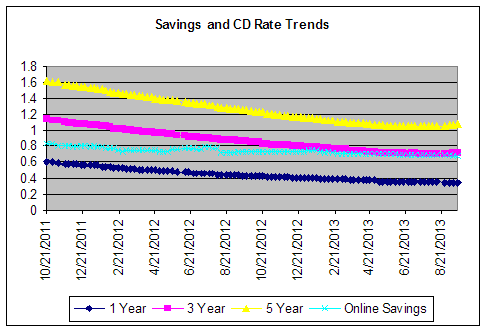
From one month ago, 12 month average CD rates decreased by two basis point from 0.353 to 0.351% APY. They actually rose slightly at the beginning of September before falling back, the first rise in over two years. Average 3 year CD rates increased from 0.710 to .715% APY and 5 year average CDs increased from 1.056% to 1.073% APY, up from their low of 1.049% APY in June. This increase may seem minor, and it is, but it is the most sustained increase we have seen in deposit rates since the middle of the financial crisis in 2008-2009. Online savings rates did not join in on the party and fell slightly from 0.689 to 0.681% APY. Online savings accounts have been the bright spot of the last couple of years, retaining relatively high rates even while CD rates crashed. If CD rates continue to rise it seems likely online rates will rise with them.
* * * *

Keep track of deposit rates

If you have not already, sign up for the BestCashCow Weekly Rate Update Newsletter and get the best rates from your state or from around the country delivered right to your email box. It's free and takes 30 seconds to do. Sign up.

* * * *

All signs point to the economy gaining momentum through the end of this year and into next year. I do believe that this economic upturn is real and that rates will continue to slowly rise from this point (as long as the Federal government does not botch the recovery with bad policy).

The chart below shows the trend in average rates since October 2012.
Top Rate Recap

During this period, top savings and CD rates stayed pretty much status quo.

  • Online Savings: AmTrust Direct dropped its rate from 1.05% APY to 0.80% APY, ceding the top spot among nationally available online savings accounts to GE Capital Bank at 0.90% APY.
  • 1 Year CD: Nationwide Bank holds the top spot at 1.06% APY with a $100,000 minimum balance. GE Capital Bank is right below it with a 1.05% APY rate and a smaller $500 minimum balance.
  • 3 Year CD: Last month, the best rate was 1.30% APY but Salem Five Direct is offering a 3-year CD that pays 1.50% APY.
  • 5 Year CD: iGoBanking.com continues to offer a 2.05% APY CD while EverBank offers a 2.04% APY CD.
  • Rewards Checking: Hope Credit Union and Money One Federal Credit Union both have the top rewards checking rate of 3.01% APY for balances up to $10,000. Both credit unions are open to members from across the country.

It's possible to find even better rates at local banks and credit unions (especially for CDs). You can search for better local rates here.

Online Saving and CD Spread

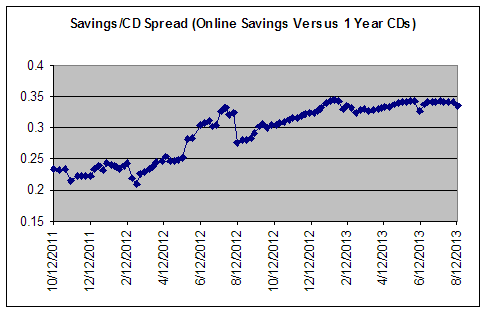
The difference between average 1 year CD rates and average online savings rates continued to gradually decline from the high it achieved in May 2013. On average, online savings account rates pay 0.330 percentage points more than 1 year CDs, up from 0.23 percentage points more at the beginning of last year but down from the spread's high of 0.344 percentage points in May. In addition to paying more than 1 year CDs, online savings rates pay almost the same as 3 year CDs. Despite the fact that online savings rates have lost some ground to 1 year and 3 year CDs, in a rising rate environment, it makes more sense to stay liquid with an online savings account than to lock money into a low rate CD. If the spread declines dramatically then this may be worth revisiting.
General rate environment

It's clear that longer-term rates want to run. Five year CD averages increased by 18 basis points and the rate rise appears to be accelerating. The increase in rates is also filtering down to 3 year and even 1 year CDs.

The Fed is the single biggest driver of rates at the moment and the lack of clarity about who will succeed Ben Bernanke as Chariman has thrown the markets for a loop. Larry Summers was thought to be more liable to raise rates sooner rather than later while Janet Yellen, now the leading candidate, is more prone to stick with current Fed policy. Either way, a growing U.S. economy will make it unlikely that rates will be able to go back down. That is not to say rates will spike up significantly. For deposit accounts, I expect the way up for now will be as gradual as the way down has been for the last three years. Depositors waiting for CD yields of 5% will still have a wait of years while the U.S. economy fully deleverages and heals from the financial crisis. My best guess is it will be sometime in 2017 before we see a 5% CD.

So if we look at the scorecard:

  • Taxes: Increasing - drag on growth. Stable.
  • U.S. economic growth: Slow to moderate. Improving. A protracted fight on the debt ceiling could hit growth and lower rate gains.
  • Europe and the world: Europe leaving recession; Japan strong growth; developed world slowing but still growing. Overall, world picture is improving. Improving.
  • Technology: Other than fracking, no innovation that seems capable of spurring growth at the moment. Stable.

My outlook: Savings and CD rates have stabilized and will not fall significantly lower. Long term rates will continue to drift up and short term rates may rise slightly. The Fed will increase the Federal Funds rate within the next 12 months. Savings rates will hover in the 2-3% range by the end of next year.

Savings Accounts or CDs?

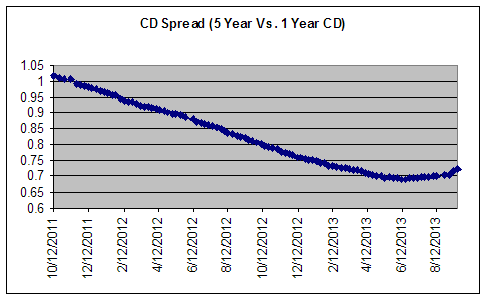
The data continues to show that opening a savings account is a better bet than a 1-3 year term CD and I expect this to hold through 2013. Online savings accounts have held the line over the past year and even though CD rates have stabilized and ticked up, the premium is still not enough to jusity locking the money away. While the premium for opening a 5 year CD over a 1 year CD has increased over the past six weeks, it is still only at 0.722 versus over 1 percentage point in October 2011. In a rising rate environment, it does not make sense to tie up money for 5 years with only a 30 basis premium.

Is it worth it to go long and open a 5 year? I don't think so any more. I think the 5 year CD rates are just too low and that you'd be better off putting your "safe" money into an online savings account and waiting for rates to rise. I spoke to one banker several weeks ago who said that "no one was investing in long-term CDs." Keep your powder dry.

For money you want to keep liquid, go with online savings accounts. They offer better rates than 1-3 year CDs and athough several banks have dropped rates in the past month, they have still offered decent rate stability over the past year and a half.

Make the best of a tough savings situation in 2013

Yields may be low in 2013 but a savvy saver can boost the return with no increase in rate by rate shopping. By shopping around, a saver can earn an extra half to full percentage point. On $100,000, that's $1,000 in extra cash per year. Remember, even in today's environment, there is competition for your cash.

Get Our Weekly Rate Update E-mail Newsletter

If you haven't already, sign up for the BestCashCow Weekly Rate Update Newsletter and get the best rates from your state or from around the country delivered right to your email box. It is free and takes 30 seconds to do. Sign up.