dollars image

1-Year CD Rates from Online Banks 2026

1-Year CD Rates from Online Banks 2026

Recent Articles


How to Invest In Certificates of Deposit

Rate information contained on this page may have changed. Please find latest cd rates.

Sustained, historically low interest rates have made CDs a less interesting part of an investor's portfolio, but can they still provide value when compared to a savings account?

Consumers seeking risk-free returns above savings rates frequently turn to Certificates of Deposit (CDs) because these securities traditionally feature interest rates higher than regular savings accounts and offer the same FDIC insurance. Banks have a contractual obligation to pay out interest over the life of the security and to pay back depositor principal when the security matures, The United States government, through the FDIC, insures up to $250,000 per bank per individual, thus eliminating institutional risk, making it an even more attractive investment option for the risk-averse investor.

Traditional CDs involve depositing a fixed amount of money for a fixed period of time in exchange for a fixed rate of interest, paid out at regular intervals, plus the repayment of the principal once the CD matures. They also carry significant penalties should the owner seek to redeem the CD early (usually ranging from the forfeiture of 3 months to 1 year of interest which may, depending on the circumstance, include the loss of principal). In today's low rate environment banks have become creative and many structure CD products with additional features suited to investors seeking additional upside (such as CDs with variable rates tied to a specific equity or bond index) or more flexibility (lower withdrawal penalties and special redemption features should the owner die). The downside to these more exotic CD products is that they are more complicated and carry more risk.

There are several factors an investor should consider prior to investing in CDs. How long is the investor willing to tie up their money? Since cash invested in CDs cannot be accessed early without penalty, it's important an investor be sure they won't need the funds prior to the security’s maturation. Another important consideration of the security is the interest rate and overall yield of the product. The interest rate, presented by the bank to investors as the APR or Annual Percentage Rate is the interest rate being offered on that particular CD. The APY, or Annual Percentage Yield, quantifies how much an investor will earn over the life of the CD as their money compounds. For example, if a CD pays an APR of 3%, that is the offered interest rate. If 1,000 is deposited into a CD that has an APR of 3%, an individual will earn $30 by the end of the first year. That $30 is then added to the principal and the 3% APR is applied to this new, higher total resulting in a higher level of interest earnings by the end of the second year, in this case $31.

Interest expectations are also an important factor. An investor who believes that interest rates will rise in the short term, will want to invest in shorter term CDs or even savings accounts, to keep their funds more liquid. An investor who believes that interest rates will fall in the future, should invest in longer term CDs, locking in higher rates.

Historically, “laddering” CDs has been a highly popular and effective method of investing. Laddering involves depositing money into a number of different CDs with varying maturities, short term, medium term and long term. This ensures a regular cash flow and provides liquidity as CDs mature that can enable the investor to take advantage of changes in interest rates. Unfortunately in a low interest rate environment this strategy has proven to be less effective than in the past.

To remain liquid in a low rate environment, some investors modify the traditional laddering approach by employing what is known as “short laddering”, where the maturities of the CDs are not as spread out but instead concentrated on short duration certificates. This maintains some yield and also keeps the investor's funds relatively liquid should interest rates rise or other investment opportunities arise.

Another option is an instrument known as the Bump Up CD. This security features a one-time option held by the investor to request a rate increase on their investment should interest rates rise. The drawback is that the initial APR offered is lower than a comparable CD without the Bump Up option embedded. Thus, if interest rates do not rise, your return will be lower than it would have been if you had stuck to investing in traditional CDs. The most interesting Bump Up CDs these days are offered by Ally Bank where they are called Raise Your Rate CDs and can be purchased for 2-year and 4-year time periods. As of this writing, these are offered at 1.09% APY and 1.35%, respectively.

Simply shopping around for the best rate might represent the most effective and least risky approach to generating satisfactory return from investing in CDs. One way to do this is to seek out institutions offering promotional or bonus rates on their products. These are typically offered by credit unions or smaller community banks, so they can be hard to find. Additionally, they frequently only apply to funds coming from elsewhere, so existent customers cannot take advantage of the offer. Another drawback is that many credit unions have membership restrictions so if you don’t live in a certain geographic area or aren’t employed by a specific company you aren’t eligible. All current CD rates at online banks, local and regional banks and credit unions are detailed here.

The most effective and time saving approach is to use websites like BestCashCow, which displays rates from throughout the industry in one place. This enables investors to make quick and comprehensive comparisons of the rates currently available and make an informed decision based off that information. With yield often hard to find, resources like this are becoming increasingly valuable tools for those determined to squeeze every last penny out of their investments.
Savings and CD Rate Update - January 28, 2012

Rate information contained on this page may have changed. Please find latest cd rates.

Top Savings Rate 1.25% APY. Other bank averages down. Mortgage rates falling with deposit rates. Rate forecast and more.

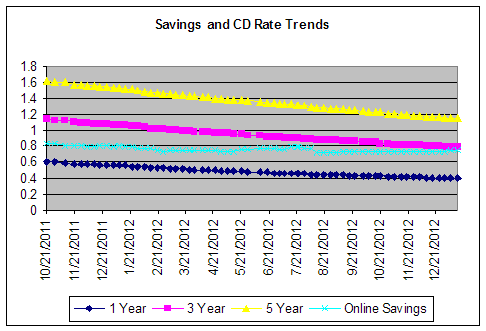
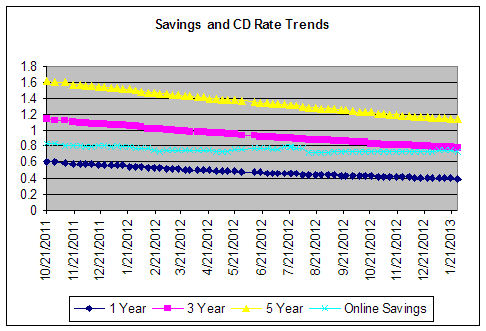
New week, same story. Average bank rates continue their slow, quicksand-like fall. Average one-year CD Rates dipped from .398% to .395% APY. Three year average CD rates dropped from .785% to .780% APY. Five year average CDs dropped to 1.135% APY from 1.147% while online savings accounts dipped slightly from .742% to .738% APY.

Looking beyond averages, the top rates in some select categories are:

Local banks and credit unions often offer better rates (especially for CDs) than online banks so be sure to check them out. View local CD rates in your area.

The chart below shows the trend in average rates since October 2012.

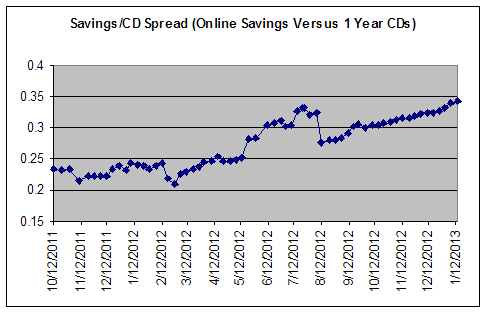
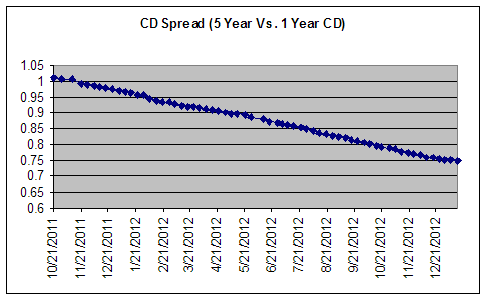
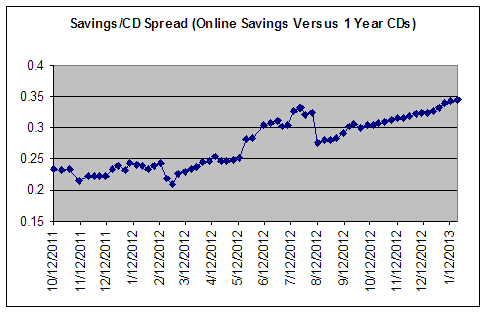
The difference in the rate of decline between online savings and CD rates can be viewed on the chart below, which shows the spread between online savings account rates and 12 month CDs. After hitting a new high several weeks in a a row, the spread dropped a bit to .343 percentage points. On average, online savings account rates pay .343 percentage points more than 1 year CDs, up from .23 percentage points more at the beginning of last year.

Mortgage Rates

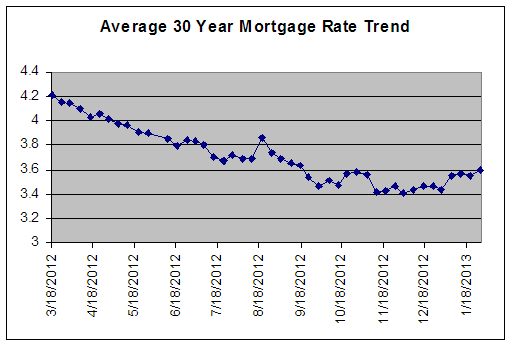
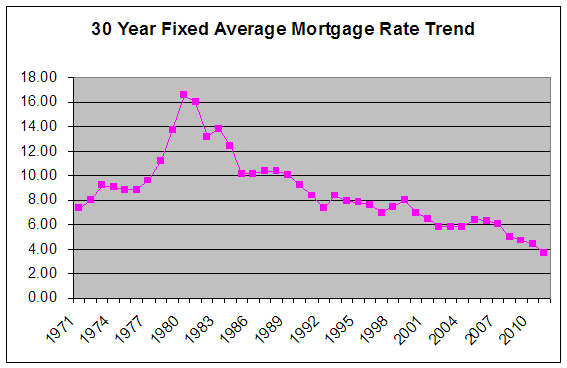
This week I thought I would take a look at mortgage rates. While savers have suffered over the past five years, borrowers have benefited from the rock-bottom rates. How low? The chart below shows what rates have done over the past 40 years (data from Freddie Mac).

We're talking historical lows. Notice that after the peak in 1980, rates have trended down regardless of recession or boom. The downturn in rates has been a long-term trend. This trend has bottomed out. Rates don't have that much lower to go. So, while the Fed has indeed engineered extremely low rates over the past four years, this trend was already well in place before the financial crisis. Average rates in 2005, before the Fed intervened were 5.87%, extremely low by the standards of the past forty years and one factor in the housing rise and fall in the 2000s.

Will morgage rates go back up? Absolutely. When? It's hard to know but I'd guess around the same time that savings and CD rates begin to rise - in about 12 - 18 months. Mortgage rates are already off their absolute bottom as regulation and fees from Fannie Mae and Freddie Mac drive up lending costs.

Even when rates go up, I don't expect them to soar. My hypothesis is that the slow growth, low rate environment we are in is a demographic issue tied to the aging of the population and workforce. Caring for the growing percentage of eldely citizens will take an economic toll across the developed and developing world. Until we figure out a better way of caring for the elderly, this burden will be a severe drag on economic growth, keeping rates low.

General rate environment

My forecast remains unchanged. I am forecasting that deposit rates will continue to gradually move lower in 2013. My reasoning includes:

  • The Fed has committed to keeping rates exceptionally low as long as unemployment is above 6 1/2 percent. It currently stands at 7.9%. At the current rate of decline, it will take at least 2-3 years to get to 7.9%. If the economy picks up, it could get there sooner.
  • The economy has picked up a bit of steam in the last couple of quarters. But GDP growth of 1-2% will not be enough to quickly bring down the unemployment rate. I project steady but moderate economic growth of around 2.5% in 2013.
  • Bank are awash in cash from individuals and corporations and do not need more deposit dollars. Third quarter 2012 FDIC data showed banks had over $9 trillion in deposits, up from $8.5 trillion in the third quarter of 2011. Many banks are having trouble figuring out how to deploy their cash. Part of this is because of lending fears and credit quality and the other part is due to increased governmental oversight.
  • Demographic trends are unfavorable. Unfortunately, the United States has entered a demographic slide. As the large baby boom generation ages and retires, this puts a large strain on the country's productivity and spending. I believe that demographics is a general driver of economic development. A young population lifts all boats. An aging will leave quite a few boats stranded and make it difficult for the others. Japan and Europe have even worse demographic problems and their economies reflect that. As China's population ages, look for its growth to ebb. This demographic slide will be a factor for the next ten to twenty years, not stopping growth, but certainly acting as a headwind.
  • Government grid-lock over the debt ceiling and sequestration. Gridlock continues and although unlikely the U.S. could begin to default on its obligations if the debt ceiling is not raised. Either way, the partisan bickering does little to establish confidence.

Potential positive Black Swans (unforseen events that could skew the forecast). Read my article from several weeks ago on Black Swans and how they impact forecasts.

Negative:

  • A major natural disaster, pandemic, or terrorist attack.
  • A major bank collapse in Europe, China, or Japan.
  • War in the Middle East (not exactly unforseen)
  • A major political change that causes conflict or threatens established institutions

Positive:

  • A technology break-through related to energy, medicine, communications, transportation, or some other field.
  • General lifting of pessimism.

If you have any more Black Swans, post them below. I'm an optimist so I'd like to think that progress and achievement will win out. It's why I'm banking on rates going up in the next 12-18 months. Minus any major black swans, here is my savings rate forecast for 2013.

My outlook: Savings rates will continue to drift lower for the next 12-18 months before beginning to move higher. How high and how fast they move will depend on the government's ability to stop bickering and resolve their budget and borrowing disputes, the continuation of a recent economic uptick, technological advances, and the ability of Europe to put its woes behind it and resolve its fiscal problems.

Check in every week for a discussion of these factors are changing and how they impact my rate forecast. Feel free to comment with your thoughts below and add any potential Black Swans that may change the course of the economy and rates.

Savings Accounts or CDs?

The data shows that opening a savings account is a better bet than a 1-3 year term CD and I expect this to hold through 2013. Many online banks have raised their savings rates over the past six months while CD rates continue to fall.

So for now, here are my recommendations:

For money you want to keep liquid, go with online savings accounts. They offer better rates than 1-3 year CDs and have shown good rate stability over the past year.

For longer-term money, look to open 4-5 year CDs at local community banks. BestCashCow research has shown that community banks and credit unions offer the most competitive rates on longer-maturity CDs.

I believe this is the best and easiest strategy for keeping your cash liquid and maximizing your savings over the next year.

Make the best of a tough savings situation in 2013

Yields may be low in 2013 but a savvy saver can boost the return with no increase in rate by rate shopping. By shopping around, a saver can earn an extra half to full percentage point. On $100,000, that's $1,000 in extra cash per year. Remember, even in today's environment, there is competition for your cash.

As always, I welcome your thoughts and comments.


Savings and CD Rate Update - January 13, 2013

Rate information contained on this page may have changed. Please find latest cd rates.

Average CD rates continue to drop while average online savings remain firm. Top nationally available rate is 1.85% APY. Rate outlook is still for gradual decline in rates until 2014.

It's the second week in January and the downward trend continues for all but online savings accounts. One year average CD Rates moved from 0.403% to 0.400% APY and by next week should be below the .40% APY mark. Five year average CDs dropped from 1.156% to 1.147% APY, one of the largest weekly drops in the past year. Average Online Savings Rates remained steady at .742%.

The top nationally available rates have all remained steady from last week::

There are plenty of local CD rates that beat these nationally available online rates, especially in the longer-term CDs. Check local CD rates.

BestCashCow Mention in the WSJ

The weekend edition of the Wall Street Journal published an article entitled "Finding High Rates Online" that mentioned BestCashCow and quoted yours-truly on the behavior of online savings rates. It discussed that while some banks have lowered online savings account rates over the past year, other banks have raised their rates, including Ally Bank, American Express, ableBanking, and SalemFiveDirect.com. It continues the narrative we've been discussing in previous weeks of how online savings rates have held up pretty well over the past year.

The chart below shows the trend in average rates since October 2012.

The difference in the rate of decline between online savings and CD rates can be viewed on the chart below, which shows the spread between online savings account rates and 12 month CDs. Last week this spread hit a 12 month high of .342 percentage points, eclipsing last week's 12 month high of .339. On average, online savings account rates pay .342 percentage points more than 1 year CDs, up from .23 percentage points more at the beginning of last year.

General rate environment

My forecast remains unchanged from last week. I am forecasting that rates will continue to gradually move lower in 2013. My reasoning includes:

  • The Fed has committed to keeping rates exceptionally low as long as unemployment is above 6 1/2 percent. It currently stands at 7.9%. At the current rate of decline, it will take at least 2-3 years to get to 7.9%. If the economy picks up, it could get there sooner.
  • The economy has picked up a bit of steam in the last couple of quarters. But GDP growth of 1-2% will not be enough to quickly bring down the unemployment rate. I project steady but moderate economic growth of around 2.5% in 2013.
  • Bank are awash in cash from individuals and corporations and do not need more deposit dollars. Third quarter 2012 FDIC data showed banks had over $9 trillion in deposits, up from $8.5 trillion in the third quarter of 2011. Many banks are having trouble figuring out how to deploy their cash. Part of this is because of lending fears and credit quality and the other part is due to increased governmental oversight.
  • Demographic trends are unfavorable. Unfortunately, the United States has entered a demographic slide. As the large baby boom generation ages and retires, this puts a large strain on the country's productivity and spending. I believe that demographics is a general driver of economic development. A young population lifts all boats. An aging will leave quite a few boats stranded and make it difficult for the others. Japan and Europe have even worse demographic problems and their economies reflect that. As China's population ages, look for its growth to ebb. This demographic slide will be a factor for the next ten to twenty years, not stopping growth, but certainly acting as a headwind.
  • Government grid-lock over the debt ceiling and sequestration. Gridlock continues and although unlikely the U.S. could begin to default on its obligations if the debt ceiling is not raised. Either way, the partisan bickering does little to establish confidence.

Potential positive Black Swans (unforseen events that could skew the forecast). Read my article from last week on Black Swans and how they impact forecasts.

Negative:

  • A major natural disaster, pandemic, or terrorist attack.
  • A major bank collapse in Europe, China, or Japan.
  • War in the Middle East (not exactly unforseen)
  • A major political change that causes conflict or threatens established institutions

Positive:

  • A technology break-through related to energy, medicine, communications, transportation, or some other field.
  • General lifting of pessimism.

If you have any more Black Swans, post them below. I'm an optimist so I'd like to think that progress and achievement will win out. It's why I'm banking on rates going up in the next 12-18 months. Minus any major black swans, here is my savings rate forecast for 2013.

My outlook: Savings rates will continue to drift lower for the next 12-18 months before beginning to move higher. How high and how fast they move will depend on the government's ability to stop bickering and resolve their budget and borrowing disputes, the continuation of a recent economic uptick, technological advances, and the ability of Europe to put its woes behind it and resolve its fiscal problems.

Check in every week for a discussion of these factors are changing and how they impact my rate forecast. Feel free to comment with your thoughts below and add any potential Black Swans that may change the course of the economy and rates.

Savings Accounts or CDs?

The data shows that opening a savings account is a better bet than a 1-3 year term CD and I expect this to hold through 2013. Many online banks have raised their savings rates over the past six months while CD rates continue to fall.

So for now, here are my recommendations:

For money you want to keep liquid, go with online savings accounts. They offer better rates than 1-3 year CDs and have shown good rate stability over the past year.

For longer-term money, look to open 4-5 year CDs at local community banks. BestCashCow research has shown that community banks and credit unions offer the most competitive rates on longer-maturity CDs.

I believe this is the best and easiest strategy for keeping your cash liquid and maximizing your savings over the next year.

Make the best of a tough savings situation in 2013

Yields may be low in 2013 but a savvy saver can boost the return with no increase in rate by rate shopping. By shopping around, a saver can earn an extra half to full percentage point. On $100,000, that's $1,000 in extra cash per year. Remember, even in today's environment, there is competition for your cash.

As always, I welcome your thoughts and comments.