dollars image

1-Year CD Rates from Online Banks 2026

1-Year CD Rates from Online Banks 2026

Recent Articles


Bank Saver Update: Deposit Rates on the Rise?

Rate information contained on this page may have changed. Please find latest cd rates.

Last month, we reported on the first increase in 3 and 5 year CD rates that we had seen in over two years. We wondered if the trend would continue despite the Fed trying to talk rates down. The good news is that...

Last month, we reported on the first increase in 3 and 5 year CD rates that we had seen in over two years. The increased occurred against the backdrop of a runup in bond and mortgag rates in the wake of the Fed's announcement that it might begin to pull back on its stimulus measures. The Fed quickly moved into damage control to talk rates back down and indicated a pullback in bond buying would not happen if the economy remained weak. So, we wondered what would happen to CD rates?

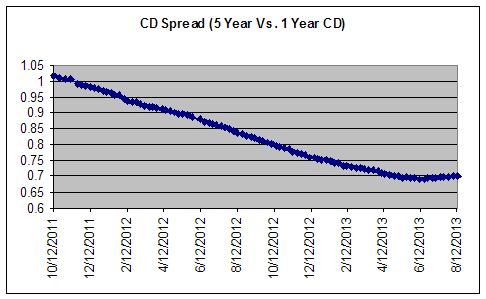
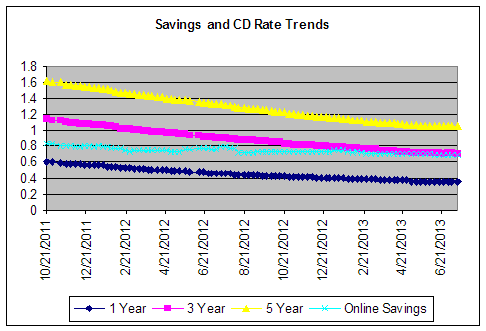
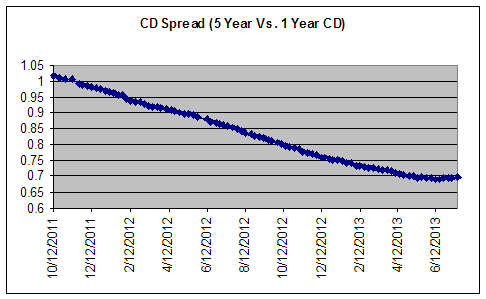
The good news, is that 3 and 5 year CD averages continue to show signs of life. From one month ago, 12 month average CD rates decreased by a measly one basis point from 0.354 to 0.353% APY. Average three year CD rates remained flat at 0.711% APY and 5 year average CDs increased from 1.052% to 1.056% APY, up from their low of 1.049% APY in June. This increase may seem minor, and it is, but it is the most sustained increase we have seen in deposit rates since the middle of the financial crisis in 2008-2009. The chart below shows that change that has occured when we examine the spread between 1 and 5 year CD rates. Long term rates have reversed their relative decline, pointing to a shift in economic and rate conditions.
All signs point to the economy gaining momentum through the end of this year and into next year. I do believe that this economic upturn is real and that rates will continue to slowly rise from this point (as long as the Federal government doesn't botch the recovery with bad policy).

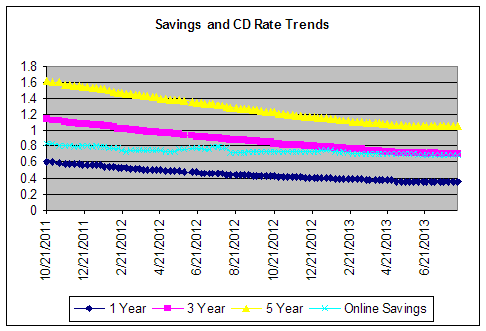
The chart below shows the trend in average rates since October 2012.
Top Rate Recap

During this period, top savings and CD rates stayed pretty much status quo.

  • Online Savings: AmTrust Direct retains the top spot at 1.05% APY.
  • 1 Year CD: GE Capital Retail Bank continued to hold the top spot at 1.05% APY. GE Capital Bank now also has the top spot. To read about the differences between these two GE-based banks, please read here.
  • 3 Year CD: Barclays Bank Delaware has dropped their formerly best rate from 1.35% to 1.25% APY. CIT and GE Capital Retail Bank now have the best rate at 1.30% APY.
  • 5 Year CD: One month ago the best rate was Barclays Bank Delaware, and CIT Bank offering 1.75% APY. iGoBanking.com now offers a 2.05% APY CD while EverBank offers a 2.04% APY CD. As we discussed above, 5 year CD rates and averages are showing signs of upward momentum.
  • Rewards Checking: Hope Credit Union and Money One Federal Credit Union both have the top rewards checking rate of 3.01% APY for balances up to $10,000. Both credit unions are open to members from across the country.

It's possible to find even better rates at local banks and credit unions (especially for CDs). You can search for better local rates here.

Online Saving and CD Spread

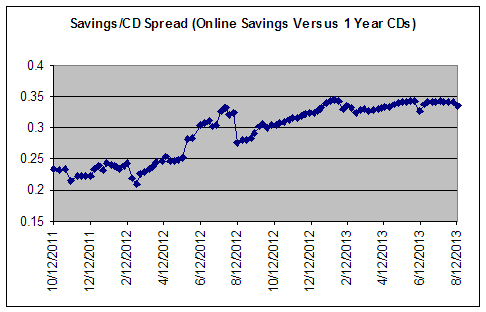
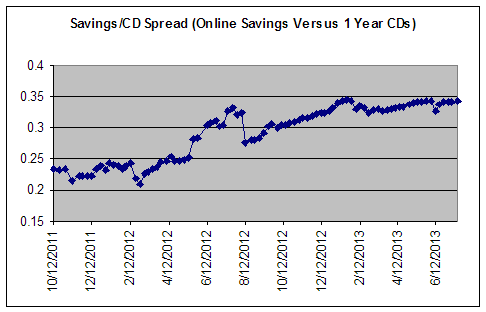
The difference between average 1 year CD rates and average online savings rates can be viewed on the chart below. On average, online savings account rates pay 0.336 percentage points more than 1 year CDs, up from 0.23 percentage points more at the beginning of last year and approaching the spread's high of 0.344 percentage points in late January. In addition to paying more than 1 year CDs, online savings rates pay almost the same as 3 year CDs. In a rising rate environment, it makes more sense to stay liquid with an online savings account than to lock money into a low rate CDs.
General rate environment

Last month, I wrote: "I didn't and still don't predict savings and CD rates to rise for 6-12 months." I'm not second-guessing that statement. Longer-term CD rates are moving up although savings and shorter-term CDs have stabilized. I didn't think rates would begin to move up for another 5-11 months. Even though I was more optimistic than most economists, I now think the timeframe has shortened.

The Fed's statements in June and July were undoubtedly a signal to the market that bond purchases were not going to continue forever. The market has digested that information and is now prepared for the Fed to begin tapering as early as next month. WSJ’s Damian Paletta wrote this morning that:

"Economists expect the steady—if unspectacular—growth will be enough for the Fed to begin cutting back on its bond purchases this year. 'The Fed needs a continuation of growth, not a notable acceleration to get that first decision to pull back," said Nomura's Lewis Alexander, who expects an announcement to come after the Sept. 17-18 Federal Open Market Committee meeting.'"

So if we look at the scorecard:

  • Taxes: Increasing - drag on growth. Stable.
  • U.S. economic growth: Slow to moderate. Improving.
  • Europe and the world: Europe leaving recession; Japan strong growth; developed world slowing but still growing. Overall, world picture is improving. Improving.
  • Technology: Other than fracking, no innovation that seems capable of spurring growth at the moment. Stable.

My outlook: Savings and CD rates have stabilized and will not fall significantly lower. Long term rates will continue to drift up. The Fed will increase the Federal Funds rate within the next 12 months. Savings rates will hover in the 2-3% range by the end of next year.

Savings Accounts or CDs?

The data continues to show that opening a savings account is a better bet than a 1-3 year term CD and I expect this to hold through 2013. Online savings accounts have held the line over the past year while CD rates continue to fall. While the premium for opening a 5 year CD over a 1 year CD has increased over the past six weeks, it is still onlyl at 0.703 versus over 1 percentage point in October 2011. In a rising rate environment, it does make sense to tie up money for 5 years with only a 30 basis premium.

Is it worth it to go long and open a 5 year? I don't think so any more. I think the 5 year CD rates are just too low and that you'd be better off putting your money "safe" money into an online savings account and waiting for rates to rise. I spoke to one banker several weeks ago who said that "no one was investing in long-term CDs." Keep your powder dry.

For money you want to keep liquid, go with online savings accounts. They offer better rates than 1-3 year CDs and athough several banks have dropped rates in the past month, they have still offered decent rate stability over the past year and a half.

Make the best of a tough savings situation in 2013

Yields may be low in 2013 but a savvy saver can boost the return with no increase in rate by rate shopping. By shopping around, a saver can earn an extra half to full percentage point. On $100,000, that's $1,000 in extra cash per year. Remember, even in today's environment, there is competition for your cash.

Get Our Weekly Rate Update E-mail Newsletter

If you haven't already, sign up for the BestCashCow Weekly Rate Update Newsletter and get the best rates from your state or from around the country delivered right to your email box. It's free and takes 30 seconds to do. Sign up.
Bank Saver Update: CD Rates Increase Slightly - Will This Continue?

Rate information contained on this page may have changed. Please find latest cd rates.

For the first time in over two years, the average rates on three and five year CDs rose in the past three weeks. This is both momentous in the savings world, and a yawn.

For the first time in over two years, the average rates on three and five year CDs rose in the past three weeks. This is both momentous in the savings world, and a yawn. First, the momentous part. Over the past month, bond and mortgage rates soared as the economy seemed to gain some speed and Fed Chairman Ben Bernanke hinted that the Fed, at some later date, might begin to scale back the Fed's purchase of treasuries and mortgage backed securities. Since May, the average rate on a 30 year fixed rate mortgage have risen from 3.770% to 4.547.%. During this period, the relentless rate of savings and CD rate declines began to slow. Then, on July 1, rates on the 60 year CD increased from 1.049% APY to 1.051% APY. They increased the following weak to 1.052% APY and then held steady this weak. Great, rates are finally increasing, right?

Yes, but hold the Champagne. First, the increases are pretty minimal - 3 basis points in total. That's almost insignificant. Secondly, Mr. Bernanke has done everything since the spike in rates to reverse direction and try to talk rates down again, even stating that the Fed may not lower rates even if unemployment hits its target rate of 6.5%. I don't expect to see any significant increase in savings or CD rates for the time being and long term CD terms may even continue the decline soon unless the economy shows more signs of life.

Top Rate Recap

During this period, top savings and CD rates stayed pretty much status quo.

  • Online Savings: AmTrust Direct retains the top spot at 1.05% APY.
  • 1 Year CD: GE Capital Retail Bank holds the top spot at 1.05% APY.
  • 3 Year CD: Barclays Bank Delaware has the best rate with a 1.35% APY. CIT cut their rate from 1.35% APY to 1.30% APY.
  • 5 Year CD: Barclays Bank Delaware, and CIT Bank offer 1.75% APY.
  • Rewards Checking: Hope Credit Union and Money One Federal Credit Union both have the top rewards checking rate of 3.01% APY for balances up to $10,000. Both credit unions are open to members from across the country.

Local banks and credit unions often offer better rates (especially for CDs). You can search for better local rates here.

The chart below shows the trend in average rates since October 2012.

The difference in the rate of decline between online savings and CD rates can be viewed on the chart below, which shows the spread between online savings account rates and 12 month CDs. On average, online savings account rates pay 0.342 percentage points more than 1 year CDs, up from 0.23 percentage points more at the beginning of last year and approaching the spread's high of 0.344 percentage points in late January. Even as longer-term CD rates have stabilized and even increased, short term CDs (one year or less) have continued to fall. At the same time, online savings rates have remained relatively steady.

General rate environment

In my rate outlook, I didn't and still don't predict savings and CD rates to rise for 6-12 months. I was proven slightly wrong over the past six weeks as longer term CD rates inched up a bit, a very small bit. The Fed has pulled back and now continues to work to keep rates low. I can't help feeling that is like turning the spring tighter and tighter and that eventually, when the Fed does decide to unwind or let rates rise, they are going to climb remakably fast. We saw some of that with mortgage rates, and how they shot up on average by almost two percentage points in a six week period.

Although the economy has showed growth in fits and starts, the overall picture looks pretty much like slow, plodding growth. Economists estimate the U.S. grew at a slow 1% annual rate in the second quarter while China's economy is decelerating. And Europe remains mired in recession and high unemployment. So if we look at the scorecard:

  • Taxes: Increasing - drag on growth
  • U.S. economic growth: Slow
  • Europe and the world: Slowing growth
  • Technology: Other than fracking, no innovation that seems capable of spurring growth at the moment.

My outlook: Savings rates will continue to drift lower for the next 6-12 months before beginning to move higher. How high and how fast they move will depend on the level of local, state, and federal taxes and cuts; the continuation of a recent economic uptick; technological advances; and the ability of Europe to put its woes behind it and resolve its fiscal problems.

Savings Accounts or CDs?

The data continues to show that opening a savings account is a better bet than a 1-3 year term CD and I expect this to hold through 2013. Online savings accounts have held the line over the past year while CD rates continue to fall. As the chart shows, the premium for opening a longer-term CD has eroded significantly and continuously over the past year. While the premium for opening a 5 year CD over a 1 year CD was 1 percentage point in October 2011, it now stands at .697 percentage points. The CD yield curve has flattened considerably over the past 24 months.

Is it worth it to go long and open a 5 year? I don't think so any more. I think the 5 year CD rates are just too low and that you'd be better off putting your money "safe" money into an online savings account and waiting for rates to rise. I spoke to one banker last week who said that "no one was investing in long-term CDs."

For money you want to keep liquid, go with online savings accounts. They offer better rates than 1-3 year CDs and athough several banks have dropped rates in the past month, they have still offered decent rate stability over the past year and a half.

If you do want the slightly extra yield offered on longer-term CDs, look to open them at local community banks. BestCashCow research has shown that community banks and credit unions offer the most competitive rates on longer-maturity CDs. Otherwise, you'd be better off keeping your money liquid in an online savings account.

I believe this is the best and easiest strategy for keeping your cash liquid and maximizing your savings over the next year.

Make the best of a tough savings situation in 2013

Yields may be low in 2013 but a savvy saver can boost the return with no increase in rate by rate shopping. By shopping around, a saver can earn an extra half to full percentage point. On $100,000, that's $1,000 in extra cash per year. Remember, even in today's environment, there is competition for your cash.

Get Our Weekly Rate Update E-mail Newsletter

If you haven't already, sign up for the BestCashCow Weekly Rate Update Newsletter and get the best rates from your state or from around the country delivered right to your email box. It's free and takes 30 seconds to do. Sign up.

Are CDs Going Extinct?

Rate information contained on this page may have changed. Please find latest cd rates.

Are CDs losing their place in a saver's portfolio? Savings data seems to suggest yes, at least for now.

Are CDs Going Extinct?

For the last fifty years, CDs have been a stable part of an investor’s portfolio. Risky money went into stocks, less risky into bonds, and the money a person didn’t want to lose went into CDs. For retirees, CDs often comprised a significant percent of a saver’s portfolio.

But with interest rates at record lows, and the average rate on a 12-month CD at 0.36% according to BestCashCow data, one has to wonder if CDs have lost their place. The answer seems to be, yes.

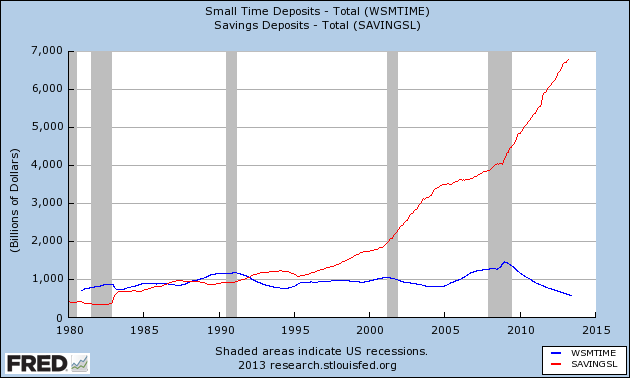
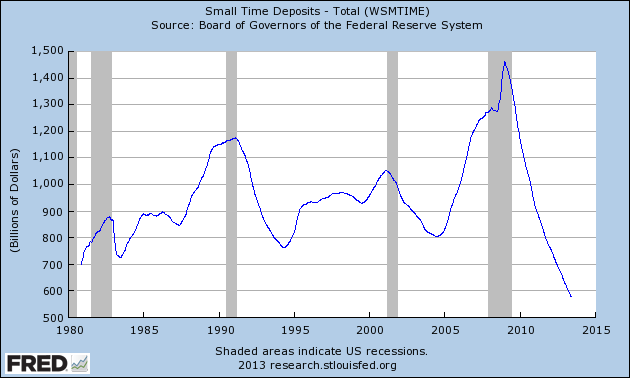
Data from the St. Louis Federal Reserve Bank shows that time deposits (time deposits are another name for CDs) have fallen sharply over the past four years since the financial crisis, and are now at the lowest level since before 1980. CD deposits have fallen by more than 50% since they peeked near $1.4 trillion in the middle of the last recession.

CD Growth Trends

My hypothesis is that low rates have forced savers to do one of two things. Either they have decided that the low rates do not warrant locking money up in a CD, and have put it into a more liquid savings account, or they have taken the money and invested it in the stock market.

The chart below shows CD deposits versus total savings deposits. Notice how savings deposits have skyrocketed since the financial crisis and not come down. Some of this may be noise due to corporate cash but the big online banks that focus on savings accounts have seen their deposit bases increase significantly in the past five years.

CD Growth Trends

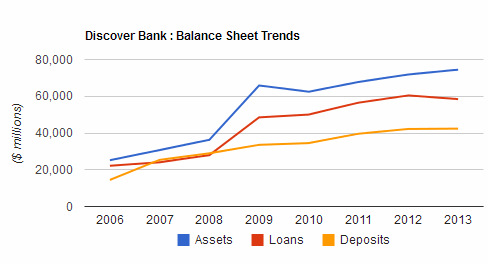
Below, Discover Bank’s deposits have grown from $28 billion in 2008 to $42 billion as of March 2013. Online banks such as American Express and Ally Bank have experienced similar growth. It appears to be true that while CD deposits have shrunk, consumer savings deposits have grown significantly over the past five years.

Discover Bank Deposit Growth

Let’s look at the second part of the hypothesis: CD owners are putting their money into the stock market. In fact, inflows into the stock market from retail investors have been very low over the past five years. By and large, the average consumer is not jumping back into the stock market.

An article by 24/7 posted on Marketwatch stated:

Are investors returning to the stock market? Absolutely they are. The DJIA and S&P 500 back at five-year highs did not come magically. But it still left much of Joe Public and retail investors on the sidelines. Now it looks as though retail investors were net buyers of stocks recently for the first time since 2007.

Net buyers for the first time since 2007! No, that CD money did not go into the stock market. Only now are consumers beginning to tip their toes back into the stock market.

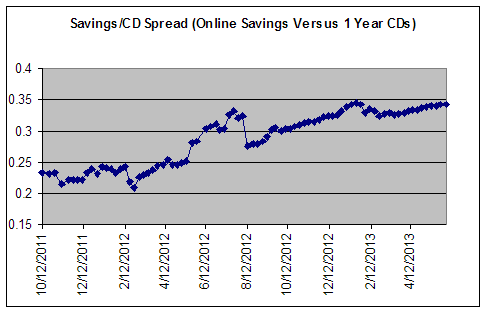
This leads me to my last chart. I post a chart like this every two weeks in my Bank Saver column examining the yield difference between savings rates and 1 year CDs.

Savings and CD Rate Comparison

The chart shows that over the past couple of months online savings accounts have paid on average .35 percentage points more than a 1 year CD, up from .23 percent more in 2011. Online savings accounts have gotten more attractive relative to CDs over time. In fact, the average savings account rate is about the same as a 3 year CD. In addition, online saving account yield have not dropped nearly as quickly as CDs, making online savings accounts a reasonable alternative to a CD.

Conclusion

Savers are eschewing CDs for savings accounts because they now pay an equivalent rate and are more liquid. Many consumers have decided that to lock money up for an extended period of time at an extremely low rate is not worth it.

This is not the end for CDs. As interest rates rise and long-term CDs start to pay a more reasonable rate, money will move back in. But for now, the extended low term cycle has put the once-popular investment option on the endangered species list.

Are you still putting money into CDs? Does this conclusion match your own thinking? Do you plan on putting more money into CDs over the next couple of months? We’d love to get your feedback.