U.S. Banks Closing Branches

Article Submitted by: Sean Riskowitz
Banks


For the first time since 2002, bank branch networks in the United States are getting smaller.


Submitted: Mar 10, 2010    Views: 463    Comments: 0    Likes: 2   


The days of having a banking branch on every corner of every street are over.
 
According to SNL Financial, a research firm that tracks data filed with bank regulators, the total number of retail branches in the U.S. is on pace to decline this year for the first time since at least 2002.
 
Several banks are taking the knife to their operations and national presence in order to close down branches that are viewed as unattractive. Banks such as JP Morgan Chase (JPM) and PNC Financial Services (PNC) are cutting down on overlapping branches and reducing their branch count for the first time in 8 years. Apparently banks that are expanding are doing so at a much lower pace than initially planned.
 
According to SNL, the number of bank branches in the United States has declined by about 300, or 0.3%, since June 2009. There are currently 98,913 bank branches across the nation. The FDIC says there are 6,839 commercial banks in the country, meaning each bank has, on average 14.46 branches.
 
The current number of branches is still 15% higher than in 2002, but the persistent increase in banking branches driven largely by profits generated from investment banking and derivative securities has come to a close.
 
Despite the retreat in banking locations, people are depositing more money into U.S. banks, mainly because of higher deposit insurance limits introduced by the FDIC. Retail investors still remain in cash after the credit and liquidity crisis of 2008.
 
The Federal Deposit Insurance Corp. says that in 2009, the 8,012 banks and savings institutions in the U.S. had just $12.5 billion in combined profits, down from $100 billion in 2007. A total of 140 banks failed (which is only 1.74% of the total), while 179 disappeared through mergers and acquisitions, and 702 (a troubling 8.76%) are considered by the FDIC to present significant risk. One of the reasons banks are expanding their branch networks less is the lack of lending activity these banks are engaging in, leaving the firms with less money for capital expenditures such as new branches.
 
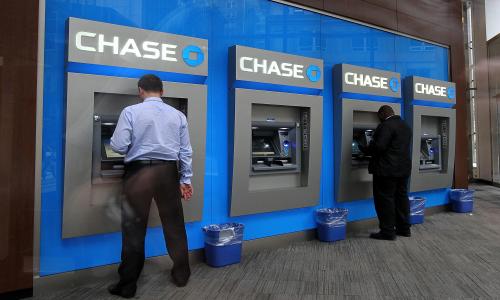
According to the an article by Robin Sidel, J.P. Morgan is scooping up former Blockbuster video-rental stores as the bank increases its retail presence in Florida. In Jersey City, NJ, a former Washington Mutual branch inherited by J.P. Morgan was transformed recently into a 7-Eleven convenience store. About 30 miles away in Morris Plains, N.J., a former WaMu location converted into a Chase branch is directly across the street from another Chase branch. Such cannibalization will inevitably lead to smaller branch networks. Chase has 377 branches in New York City with 1,862 ATMS. With a total area of 303 square miles in New York City, that’s one Chase branch every 0.8 square miles.


Updates and Offers

Subscribe to BestCashCow Weekly Bank Rate Updates and News.


Bank Deal:
Earn 2.25% 3-Month Bonus Rate on Everbank Yield Pledge Money Market Account


Related Articles:


2

Email this story Email to someone | Print Story Print Content | Add to reading list


Add Your Comments:

Your Name:

Spam protection control:


© Copyright 2010 Sean Riskowitz All rights reserved. Sean Riskowitz has granted BestCashCow.com, LLC non-exclusive rights to display this work on Bestcashcow.com.

Financial products of all nature bear inherent risks and this website is not a financial advisory service; it is a forum for users to share and to compare notes and observations on financial publications. The website provides, free of charge, the technical and logistical apparatus and the medium for users to share and to publish financial information and to comment on publications. As such, the website's operator can not and does not take responsibility for information, observations or opinions of any sort or nature provided by third parties with whom it is not affiliated who use the website to publish, to comment or as a means of solicitation. Users are specifically warned against following any advice related to specific instruments, including, but not limited to, equity securities, that may be provided by other users directly on this site or on web pages to which other users have provided links on this site. BestCashCow.com can not and does not check or verify the qualifications and credentials of users who publish or comment on this site or on linked pages. Users should seek personalized advice from qualified professionals regarding all personal financial issues and evaluate the risks and applicability to their own circumstances of each financial product discussed regardless of who the publisher is or purports to be. Should you, through your use of this site, identify an individual or organization purporting to offer personalized advice, you bear all responsibility to ensure that the individual or organization has the qualifications that they may represent on the website, and that their advice is appropriate for your circumstances. On certain webpages, BestCashCow.com provides information related to rates on US-based savings accounts, CDs, short-term government bonds, and other US cash equivalent securities, also free of charge to internet users for their independent use. The accuracy of this information is not guaranteed, and the information, like all other information on this website, should not be construed to provide investment advice, nor to endorse a financial product of any sort.

© 2010 BestCashCow.com, LLC. All Rights Reserved. Terms under which this service is provided to you. Privacy Policy.