
One question I frequently get asked when discussing bank rates is whether higher rates are usually offered by distressed banks. The thinking goes that distressed banks need to hang on to deposit dollars in order to maintain their liquidity. As a result, they offer higher rates in order to attract new money and convince depositors to keep money in the bank. Anecdotally, this is the kind of behavior we saw at the height of the financial crisis, when mega-banks like Countrywide and Indymac offered some of the highest rates in the country right before they were closed.
The question is whether a bank’s rates and its underlying financial condition are correlated?
First, it’s important to understand that banks that are highly distressed will not have high rates. Once a bank appears on the FDIC’s less than capitalized list, the agency generally prohibits it from offering rates above a national rate cap it has established.
But that still doesn’t answer the question of whether banks that offer higher rates are less financially secure. The answer is important. If high rates are usually offered by distressed banks then it may not be worth the extra yield the bank offers.
The Analysis
Two analyses were done to answer this question using data for FDIC insured banks. It's important to note that this analysis only covers FDIC insured banks. Extremely high rates offered by non-FDIC insitutions should be an immediate warning signal.
The first analyzed the correlation between average 1 year CD rates and the average Texas ratios for each state using data from BestCashCow’s database of 7,000 banks and 2,000,000 product rates. The Texas ratio compares the amount of loans at risk and the amount of owned real estate with the amount a bank has on hand to cover any losses. While it is not a definitive guide to bank risk and soundness, it has been found to be a good indicator in the past.
The data was graphed on the scatterplot below.
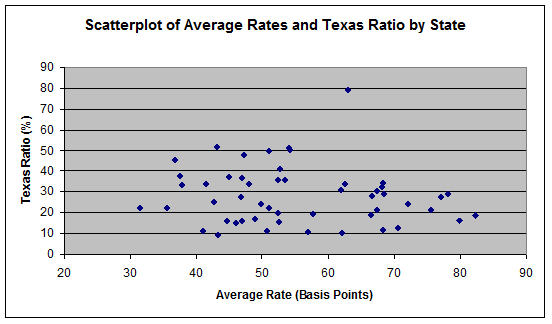
The scatterplot shows a low negative correlation between average state 12-month CD rates and state average Texas ratios which is confirmed with a coefficient of -0.12393 (with +1 showing a high positive correlation and -1 showing a high negative correlation). A negative correlation means that as the average rate rises, the average Texas ratio drops. Lower Texas ratios are a sign of a healthier bank, so on average according to this analysis, higher rates are offered by healthier banks. As the plot shows, some of the states with the highest rates, had the banks with the lowest Texas ratios (healthier banks).
Analysis 2
As a next step, I used the BestCashCow database to pull the top 100 CD rates in the country and then examined the Texas ratios of the respective banks. The average Texas ratio for this group of banks was 25.56% versus an average Texas ratio for all banks of 24.44%. Distressed banks usually have Texas ratios above 100%. This analysis shows again that banks that offer high rates are not less financially sound than the average bank.
***
While anecdotally, it may appear that high rates are offered by distressed banks, a thorough review of the data shows that in aggregate, higher rates are not a sign of a distressed banks and if anything, may be a sign of a more secure bank. With bank rates, you can have your cake and eat it.













Comments
Jay
December 09, 2013
Hello,
Are annuities safe, and if so which ones.
thank you
Is this review helpful? Yes:2 / No: 3
Add your Comment
or use your BestCashCow account