
The prevailing wisdom today amongst analysts and those “in the know” is that interest rates are poised to go higher, partly because of massive government borrowing/spending. Yet, Japan's economy over the last 20 years has shown exactly the opposite impact of high borrowing. Interest rates have dropped even as the government has added more and more debt.
There are two main reasons cited for the rising rates hypothesis in the US.
- As the supply of US Treasuries grows to finance record US budget deficits, investors will demand a higher return to soak up the flood of borrowing.
- Injections of trillions of dollars by the Fed and the Treasury will stimulate the economy and fuel inflation, which will force the Fed to raise rates.
On the surface this seems like a logical conclusion. If you flood the economy with money, you’re going to see inflation, and inflation will lead to higher rates. Right?
Well, not always. I’ve written before about Japan and their lost decade (How Low Can It Go? Comparison of the Dow Jones to Japan's Nikkei Index), or now two lost decades. I’ve also noted that I think the US situation has many similarities with Japan’s problems in the last 1980s – a massive real estate bust, a stock market crash, and perhaps the biggest and most important parallel, the insolvency of the banking sector.
There are differences. Japan is more of a saver society than the US’s consumer oriented culture. And as bad as the US bust has been, Japan's bubble was greater and its implosion worse. But since the US is the largest economy in the world, and Japan the second largest economy (although some say China has just surpassed it), I think a comparison is instructive and informative.
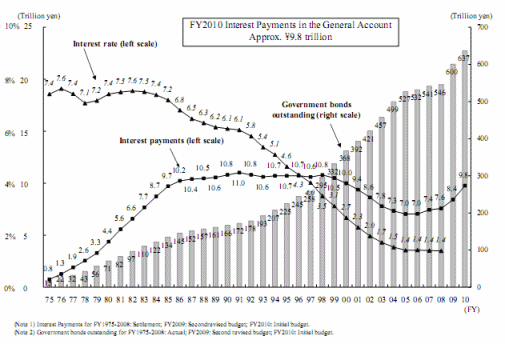
Starting in 1993, the Japanese government began to spend in an attempt to lift the country from its recession. As the chart below indicates, public debt rose quickly from 193 trillion yen in 1993 to 457 trillion yen ten years later. In addition, the Japanese central bank pioneered “quantitative easing” bringing Japanese rates down close to 0% in a further attempt to stimulate the economy. Sound familiar?
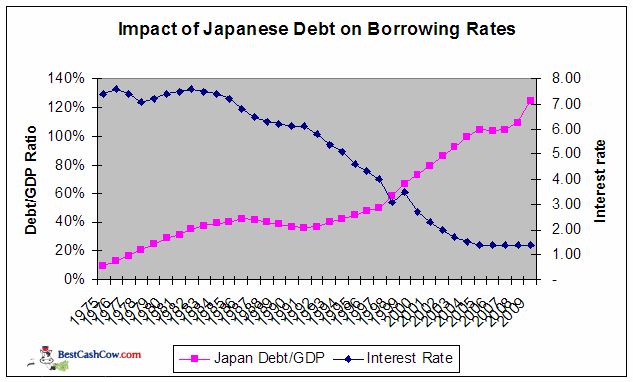
Because of this spending, the ratio of debt to GDP soared, moving from 40% in 1993 to 93% in 2003. Today, that ratio is 125%. By comparison, Greece’s debt to GDP ratio is 97.4% in 2009 according to the CIA world fact-book. Greece is considered to be standing at the edge of a financial abyss.
So, one would expect that as debt has grown, interest rates in Japan would also climb. The chart below shows that the exact opposite has happened. Even as the debt/GDP ratio crossed 100% in 2004, interest rates on Japanese debt fell to a 30 year low of 1.4% and have stayed there.
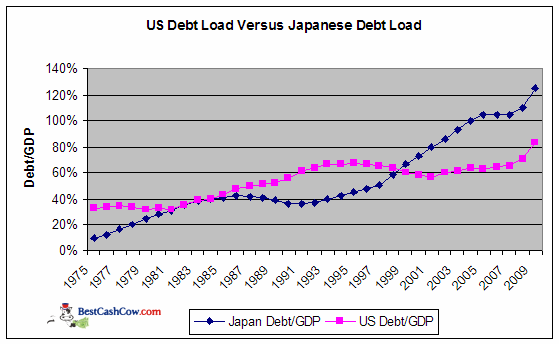
The next chart shows that compared to Japan, the US debt/GDP ratio is much lower. That is, the US, even with all of the recent spending, has a much smaller debt problem than the next largest economy in the world. Or, put another way, based on the Japanese experience, the US economy can potentially absorb a lot more debt without any increase in interest rates.
Why has Japan been able to borrow at such low rates for so long? I think it boils down to the fact that 30 years after the Japanese bubble burst, the economy still hasn’t recovered. Deflation is a bigger worry than inflation. The Japanese, thrifty to begin with, have never recovered their spending ways. And the export economy that helped lift Japan in the 1980s has stalled in the face of a global recession and competition from other Asian nations. Japan could use some inflation and the government is finding it can’t spend its way to higher prices.
Could the same thing happen in the US. Sure? It’s possible that chronic unemployment over 10% results in a long-term decline in consumer spending. It won’t be as low as Japan’s but it doesn’t need to be. It just has to be lower than it was. The gap between what people are buying and what the economy can produce will result in idle resources, which could prevent inflation. US GDP growth could amble along at 2-3%, which would be growth, but not enough to soak up the idle capacity for some time.
Add in the fact that the US still remains the safe-haven for parking cash (would you really put money in Euros at this point or even in China) and you have enough demand to soak up all of those Treasuries at a nice low rate.
The point is Japan’s experience shows that “printing money” doesn’t always lead to an inevitable increase in interest rates. Ten-year US Treasuries at 3.7%, savings accounts at 1.5%, and 30-year mortgages at 5% could be the new norm instead of a low-point before rates quickly bounce back up.













Add your Comment
or use your BestCashCow account