
The Paulson economic plan is designed to get banks lending again. The question is, to whom? Consumers are already saddled with record household debt and need time to work it down. And businesses are already sitting on records amount of cash.
The chart below shows the growth in consumer debt over the last 28 years. DSR stands for Debt Service Ratio and is an estimate of the ratio of debt payments to disposable personal income. The financial obligations ratio (FOR) adds automobile lease payments, rental payments on tenant-occupied property, homeowners' insurance, and property tax payments to the debt service ratio. The data is then broken up into renter FOR (which is not included in the chart below) and Homeowner. Homeowner FOR is then broken down into Mortgage and Consumer spending.
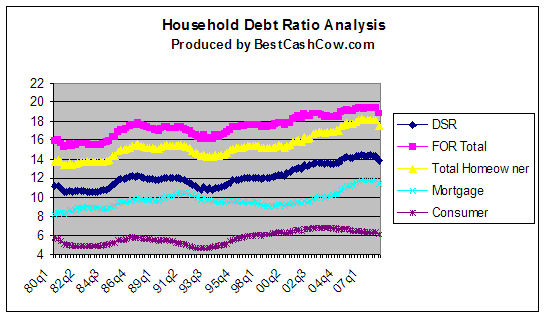
As the chart shows, all of these ratios have risen significantly since 1980, except for the Consumer spending ratio. Consumer includes payments on auto and consumer debt (credit cards). It's clear over the last five years that housing has stretched the balance sheets of many households, with mortgage payments consuming an unhealthy percent of all disposable income. According to the US Census Bureau more than 7.5 million people - almost 15 percent of American homeowners with a mortgage - are spending half of their income or more on housing costs. That is up from nearly 7.1 million the year before. Financial specialists say consumers shouldn't be using more than 30% of their income on housing costs.
So, how is more lending by banks going to help these consumers? They no longer have the ability to borrow.
Both Paulson and Bernanke argued before Congress that businesses will use their cleaned-up balance sheets to lend to businesses, creating more jobs, and keeping the economy going. Except that corporations are already flush with cash. If they aren't spending, it doesn't seem to be because of a lack of capital.
The International Herald Tribune reported in March 2008 that:
"Unlike most American consumers, whose failure to save has exasperated economists for years, the typical American corporation has increased its savings so sharply that it probably has enough cash on hand to completely pay off its debts.
That should be good news in an economy - the world's largest - unsettled by rising energy prices, tightening credit, gyrating stock prices and declining values for the dollar and the family homestead. Indeed, the Federal Reserve chairman, Ben Bernanke, cited strong corporate balance sheets as a bright spot in the darkening forecast he presented to Congress last week.
Some analysts also speculate that these cash-rich companies - which have been saving to offset the risks of doing business in a more globalized world - may start sharing their wealth with investors through special dividends, providing welcome stimulus for the economy.
Corporate spending on equipment and other capital expenditures has declined as savings have soared, suggesting that companies could stimulate the economy now by going on a hiring and spending spree."
So, who exactly are the banks going to lend to? And how is it going to help the economy if the central problem really isn't addressed - excessive consumer debt? The US economy is 70% consumer-related. Until we have all worked off all of the McMansions, new kitchens, renovated bathrooms, three car garages, etc. I wonder if helping the banks is really going to do anything.
I guess time will tell.













Comments
Sol Nasisi
September 25, 2008
I just posted a link to Reuters that shows how the meat stocks are being hit by a worry over credit. It looks like industries that rely on credit to conduct their business could be hit hard if general market conditions continue to deteriorate.
Is this review helpful? Yes:0 / No: 0
Sam Cass
September 27, 2008
Your initial article is right on. No amount of bail out can help consumers recover from the debt binge they have been on over the last twenty years. We as a country need to take our medicine and move on.
Is this review helpful? Yes:0 / No: 0
Add your Comment
or use your BestCashCow account